
Understanding Adult Learning Disabilities: Your Path to Clarity and Success
If you’re an adult seeking answers about learning challenges that have persisted throughout your life, you’re not alone. At Bridges of the Mind Psychological Services, we specialize in comprehensive evaluation for learning disability in adults using a neurodiverse-affirmative approach that recognizes cognitive differences as natural variations rather than deficits.
Learning disability conditions don’t disappear after childhood—they’re lifelong neurological conditions that affect how people process, store, and use information. Many adults struggle silently with undiagnosed learning difficulties, having developed coping strategies that mask their difficulties but don’t eliminate the underlying challenges. Our psycho educational assessment services provide transformative results, offering answers, access to accommodations, and more effective coping strategies for success.
Our team at Bridges of the Mind serves the Sacramento, San Jose, and South Lake Tahoe areas with comprehensive in-person psychological assessment services. What sets us apart is our commitment to eliminating waiting lists—we can typically schedule your comprehensive learning disability assessment within 2-3 weeks, ensuring you get the answers you need without lengthy delays.
Quick Guide to Adult Learning Disability Evaluations
Who Performs the Evaluation: Licensed psychologists and neuropsychologists who are qualified professional practitioners with specialized training in adult learning disability assessment
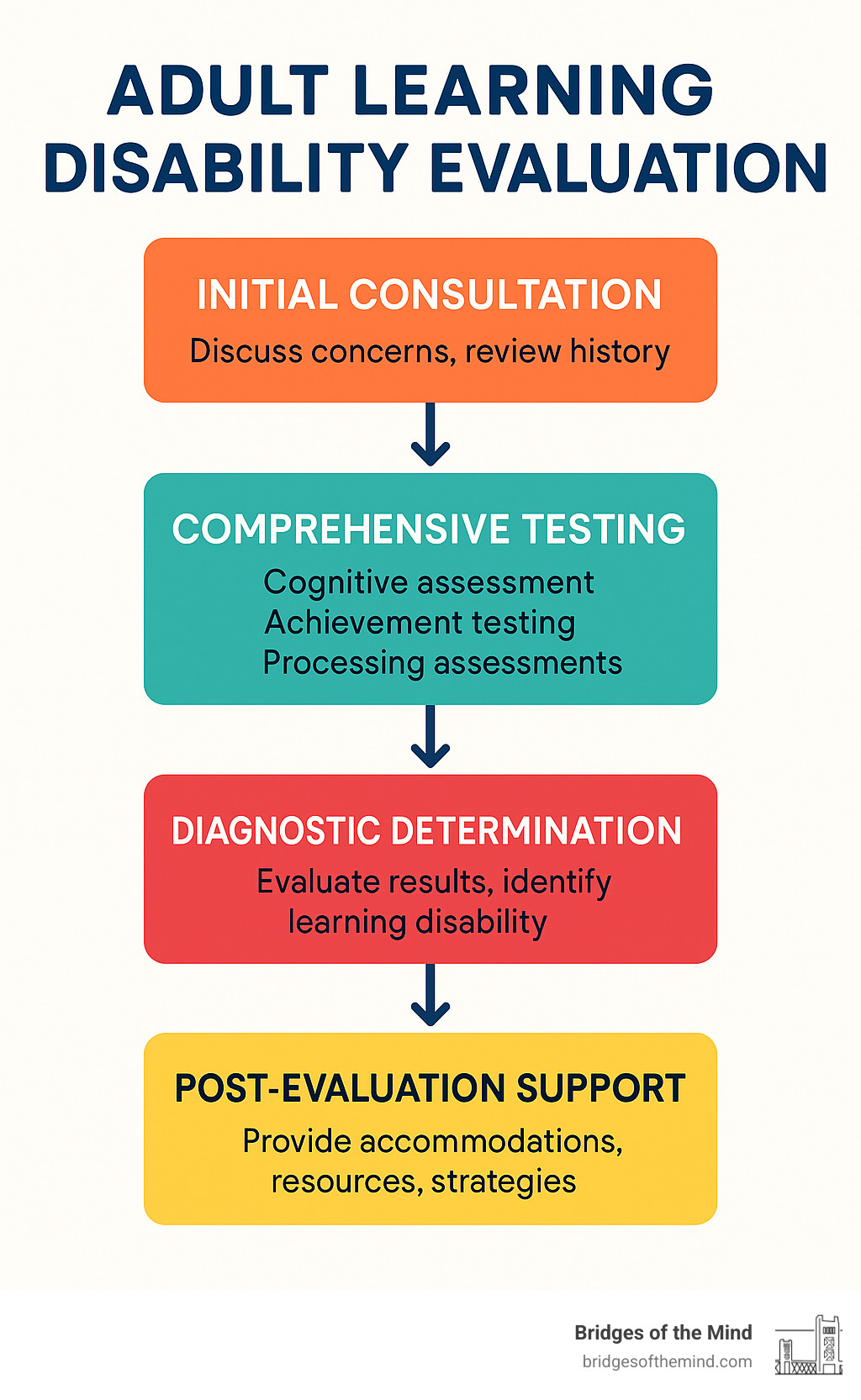
Typical Process: Initial consultation with clinical interview → Comprehensive psychological testing across several testing sessions (6-8 hours total) → Analysis and assessment report preparation → Feedback interview to discuss results and recommendations
Documentation Needed: Medical history, educational records, work samples, previous psychological evaluations if available, birth history, and relevant medical tests
Timeframe: Results typically available 2-3 weeks after testing completion
Our Approach: Neurodiverse-affirmative psycho educational assessment that focuses on strengths alongside challenges
How Learning Disabilities Present in Adult Life
Learning difficulties often manifest differently in adulthood compared to childhood. Understanding these patterns can help young adults and older individuals recognize whether a learning disability assessment might be beneficial:
Reading and Language Challenges (Specific Learning Disorder with Reading Impairment):
- Reading fatigue that leaves you mentally exhausted after short periods
- Difficulty with written communication despite strong oral language skills
- Challenges with word recognition, phonetic knowledge, and spelling consistency
- Slower reading pace compared to peers with similar intellectual functioning
Mathematical Difficulties (Specific Learning Disorder with Mathematics Impairment):
- Anxiety around everyday math computation like splitting bills or calculating tips
- Trouble with organizational and planning skills related to numerical concepts
- Difficulty understanding mathematical concepts despite effort
- Challenges with number sequencing and basic skills in arithmetic
Writing Challenges (Specific Learning Disorder with Written Expression):
- Taking significantly longer to complete written tasks
- Difficulty organizing thoughts on paper and expressing creative aspects of thinking
- Poor fine motor dexterity affecting handwriting quality
- Fatigue when writing by hand or typing, impacting workplace skills
Coordination and Motor Planning:
- Difficulty with tasks requiring fine motor dexterity and coordination
- Challenges with sequencing physical movements and life skills
- Problems with visual perception and spatial organization
Executive Functioning and Cognitive Challenges:
- Difficulty with organizational and workplace skills, planning skills, and time management
- Problems with working memory, processing speed, and following verbal instructions
- Challenges switching between tasks or adapting to changes in routine
- Trouble with self-regulation, attention span, and problem solving in complex situations
Many adults also experience co-occurring attention deficit disorder alongside learning disabilities, which can complicate both diagnosis and daily functioning. Our comprehensive psychological assessment considers your complete cognitive functioning profile, including attention patterns, working memory capacity, and executive functioning abilities.
Why Many Learning Disabilities Go Undiagnosed Until Adulthood
It’s remarkably common for learning difficulties to remain unidentified until adulthood for several reasons that our psycho educational assessment process addresses:
Effective Coping Strategies: Many intelligent adults develop sophisticated workarounds that mask their learning disability challenges. You might avoid certain tasks, work significantly harder behind the scenes, or rely heavily on assistive technology to compensate for difficulties with basic skills.
Historical Educational Practices: Young adults who attended school before comprehensive learning disability assessment became standard may have missed early identification. Limited screening meant fewer resources for recognizing learning difficulties and intellectual functioning differences.
High Intelligence Masking: Above-average intellectual functioning often allows individuals to compensate so effectively that neither they nor others notice the underlying struggles with specific academic skills or workplace skills.
Cultural and Environmental Factors: Cultural background, socioeconomic barriers, and geographic factors have historically limited access to psycho educational assessment services, preventing many from receiving proper evaluation for learning disability in adults.
Gender and Presentation Differences: Learning disability manifestations in women and certain cultural communities have been significantly underdiagnosed, particularly when emotional factors like low self esteem or poor self esteem mask cognitive challenges.
Our Comprehensive Psycho Educational Assessment Process
At Bridges of the Mind, we’ve designed our learning disability assessment process to be thorough yet comfortable. Our psychological assessment approach ensures that understanding your cognitive functioning becomes an empowering experience rather than a stressful one.
Initial Clinical Interview and Consultation
We begin with a detailed clinical interview about your experiences, challenges, and goals. This key element of our assessment includes helps us understand your unique situation and tailor the psycho educational assessment to your specific needs. We’ll discuss your educational history, work experiences, early development, neurological status, and current difficulties with organizational and workplace skills to create a comprehensive picture.
Comprehensive Psychological Testing
Our learning disability assessment involves various tests administered across several testing sessions to prevent mental fatigue and ensure optimal performance. The testing administration time varies based on individual needs, but the assessment includes these key elements:
Cognitive and Intelligence Testing: We use tools like the Wechsler Adult Intelligence Scale (WAIS-IV) to evaluate your intellectual functioning, cognitive functioning, and identify strengths and challenges across different domains. This psychological testing provides insight into how your brain processes information, including non verbal abstract reasoning abilities.
Academic Achievement Measures: Our psycho educational assessment includes tests that evaluate your current academic achievement levels in reading, writing, mathematics, and related academic areas. These help identify specific academic difficulties and learning disability patterns affecting basic skills and more advanced capabilities.
Processing Assessments: Specialized psychological testing examines how you process auditory and visual information, assess language processing abilities, and evaluate attention span and working memory capacity. These tests can identify difficulties with background noise processing and other environmental factors.
Executive Functioning Evaluation: We assess your brain’s organizational and planning skills—how you plan, organize, regulate yourself, and manage complex problem solving tasks in various life skills contexts.
Sensory-Motor Testing: These assessments help us understand how visual perception and fine motor dexterity work together, which can impact learning and organizational and workplace skills development.
Emotional Evaluations: Our comprehensive approach includes assessment of emotional factors such as self awareness, social skills, and the impact of potential low self esteem or poor self esteem on functioning.
Analysis and Diagnosis
Our team carefully interprets all psychological testing results, looking for patterns that indicate specific learning difficulties. We don’t just examine test scores—we analyze how you approach problem solving in each task, as the process often reveals more about cognitive functioning than the final answer.
Feedback Interview and Written Report
We schedule a comprehensive feedback interview to discuss our findings from the psycho educational assessment, explain what they mean for your daily life, and outline practical next steps. You’ll receive a detailed written report and assessment report that clearly explains everything and can be used for workplace accommodations at work, school, or for your personal understanding.
Types of Learning Disabilities We Assess
Our comprehensive learning disability assessment can identify various types of learning difficulties:
Specific Learning Disorder with Impairment in Reading: The most common learning disability, affecting reading accuracy, word recognition, and comprehension despite adequate intellectual functioning and instruction.
Specific Learning Disorder with Impairment in Written Expression: Affects writing abilities, including handwriting, spelling, creative aspects of written communication, and organizing thoughts on paper.
Specific Learning Disorder with Impairment in Mathematics: Impacts mathematical reasoning, math computation, and number sense, often affecting workplace skills requiring numerical abilities.
Language Processing Disorders: Affect understanding and use of spoken and written language, including difficulties following oral instructions and verbal instructions in various settings.
Visual Perception and Auditory Processing Disorders: Impact how the brain interprets visual perception information or auditory input, affecting learning and organizational and workplace skills.
Executive Functioning Disorders: Affect planning skills, organization, working memory, processing speed, and self-regulation across life skills contexts.
We also assess for co-occurring conditions such as attention deficit disorder, anxiety, and depression, which frequently accompany learning disability conditions and can impact overall cognitive functioning and workplace skills.
The Importance of Neurodiverse-Affirmative Assessment
At Bridges of the Mind, we embrace a neurodiverse-affirmative approach in our psycho educational assessment process that views cognitive differences as natural variations rather than deficits. This perspective fundamentally changes how we conduct learning disability assessment and interpret psychological testing results.
Rather than focusing solely on weaknesses or areas of challenge, our qualified professional team works to identify your cognitive functioning strengths and unique problem solving approaches. Every individual brings distinct abilities to the table—perhaps exceptional creativity, pattern recognition, big-picture thinking, or innovative problem solving skills that complement areas of learning difficulty.
Our psycho educational assessment provides a balanced understanding of both your challenges and your strengths, enabling you to leverage your natural abilities while developing more effective coping strategies to address areas of difficulty. This approach empowers you to advocate for appropriate workplace accommodations while building self awareness and confidence in your unique cognitive functioning profile.
Life After Diagnosis: Turning Results into Action
Receiving a learning disability diagnosis as an adult often brings profound relief—finally understanding why certain tasks have been challenging despite your intellectual functioning and best efforts. A diagnosis from our comprehensive psycho educational assessment isn’t an endpoint; it’s a doorway to new possibilities and more effective coping strategies.
Legal Protections and Accommodations
With proper documentation from our comprehensive learning disability assessment, you gain access to important legal protections under the Americans with Disabilities Act (ADA). These protections apply to both educational settings and the workplace, ensuring you can request reasonable workplace accommodations that level the playing field.
Educational accommodations might include extended testing administration time, alternative testing environments, note-taking assistance, or access to assistive technology. Workplace accommodations could involve modified work environments, flexible scheduling, written versus oral instructions, or adaptive technology to support organizational and workplace skills.
Assistive Technology and Tools
Modern assistive technology offers powerful solutions for many learning difficulties. Text-to-speech software can support reading comprehension and address visual perception challenges, while speech-to-text tools assist with writing tasks when fine motor dexterity is limited. Organizational apps help with planning skills and time management, while specialized software can support math computation or language processing needs.
Personalized Strategy Development
Our comprehensive assessment report goes beyond diagnosis to provide practical, personalized recommendations. We help you understand how to leverage your cognitive functioning strengths while developing compensatory strategies for areas of learning difficulty. These might include specific study skills techniques, organizational systems, or environmental modifications that support your learning style and workplace skills development.
Career and Educational Planning
Understanding your learning disability profile through our psycho educational assessment can inform important decisions about career paths, job training opportunities, educational goals, and professional development. Many adults find that their diagnosis helps them identify work environments where they can thrive and avoid workplace issues that consistently challenge their areas of difficulty.

Maintaining Current Documentation
Learning disability documentation requires periodic updating to remain valid for accommodation purposes. Most institutions require that your written report and assessment report be no more than 3-5 years old and completed when you were at least 16 years old, following guidelines established by the American Psychiatric Association.
We recommend keeping digital copies of all psychological testing reports and accommodation letters in a secure location. Setting reminders for when reevaluation might be needed can prevent delays when you need to provide current documentation for new educational programs, standardized tests, or workplace accommodations.
Finding Support and Resources
The learning disability community offers extensive support networks and resources for adults navigating life with learning difficulties. Professional organizations, online communities, and local support groups provide opportunities to connect with others who share similar experiences and challenges with organizational and workplace skills, study skills, and life skills development.
Assistive technology continues to evolve, offering new solutions and improved accessibility features for individuals with various learning difficulties. Staying informed about these developments can provide ongoing benefits for managing daily tasks, improving workplace skills, and addressing challenges with working memory, processing speed, and visual perception.
Financial Considerations and Accessibility
We understand that comprehensive psychological assessment represents a significant investment. While we cannot provide specific pricing details, we work with clients to explore various payment options. Some qualified professional services may offer sliding scale fee structure arrangements based on individual circumstances, and many clients successfully use Health Savings Accounts (HSAs) or Flexible Spending Accounts (FSAs) for psycho educational assessment services.
It’s worth exploring whether your insurance provides any coverage for psychological testing, particularly when the learning disability assessment addresses co-occurring conditions like attention deficit disorder, anxiety, or depression that may impact cognitive functioning and workplace skills.
The Bridges of the Mind Difference
What makes our approach unique is our commitment to accessibility and understanding in learning disability assessment. We’ve eliminated waiting lists because we believe that when you’re ready for answers about your cognitive functioning and learning difficulties, you shouldn’t have to wait months to begin the psycho educational assessment process.
Our team of licensed psychologists and neuropsychologists brings specialized expertise as qualified professional practitioners in adult learning disability assessment. We understand that adult presentations of learning difficulties differ significantly from childhood manifestations, and our psychological testing protocols are specifically designed for adult clients across various cultural background contexts.
We serve the Sacramento, San Jose, and South Lake Tahoe areas with comprehensive in-person psycho educational assessment conducted in a comfortable, supportive environment. Our neurodiverse-affirmative approach ensures that you’ll feel respected and understood throughout the learning disability assessment process, from the initial clinical interview through the final feedback interview.
Taking the Next Step
If you recognize yourself in these descriptions and are ready to gain clarity about your cognitive functioning profile, we’re here to help. A comprehensive learning disability assessment can provide the understanding and documentation you need to access appropriate supports and develop effective coping strategies for success in organizational and workplace skills, study skills, and life skills.
Learning difficulties don’t define your potential—they simply represent different ways your brain processes information. With proper understanding through psycho educational assessment, appropriate workplace accommodations, and personalized strategies, adults with learning disability conditions can excel in educational, professional, and personal contexts.
Contact Bridges of the Mind Psychological Services to learn more about our comprehensive evaluation for learning disability in adults. We’re committed to helping you understand your unique cognitive functioning profile and develop the tools you need to thrive. Our qualified professional team provides thorough psychological assessment services that can transform your understanding of your learning difficulties and open doors to new possibilities.
Our team is ready to support you on this journey of discovery and empowerment. Reach out today to schedule your comprehensive psycho educational assessment and take the first step toward unlocking your full potential through better self awareness and more effective coping strategies.