
Understanding Teen ADHD Testing: What Parents Need to Know
Teen ADHD testing is a comprehensive evaluation process that helps identify attention deficit hyperactivity disorder in adolescents. At Bridges of the Mind Psychological Services, we understand that the teenage years bring unique challenges for everyone, but for adolescents with ADHD, this period can be especially complex as academic demands increase and social relationships grow more intricate.
What teen ADHD testing involves:
- Comprehensive clinical interviews with teens and family members
- Standardized rating scales and ADHD assessments
- Cognitive and neuropsychological evaluations
- Review of academic and developmental history
- Multi-informant perspectives from parents, teachers, and other adults
Who performs the testing: Only trained healthcare providers including licensed psychologists and neuropsychologists with specialized training in mental disorders
Timeline: Typically 4-8 hours of testing spread across multiple sessions over 2-3 weeks
When to seek testing: Persistent focus issues, declining academic performance, organizational challenges, or emotional regulation difficulties that interfere with daily functioning
Attention deficit hyperactivity disorder affects approximately 12% of teens ages 12 to 17, making it one of the most common mental health conditions in adolescence. What makes teen ADHD particularly challenging is that ADHD symptoms often present differently than in younger children, with hyperactivity sometimes becoming less obvious while inattentive symptoms and organizational difficulties may intensify.
Many parents struggle to distinguish between typical teenage behavior and genuine symptoms of ADHD. This uncertainty is completely understandable and leads many families to seek professional evaluation from a mental health professional. At our practice, we take a neurodiversity-affirmative approach that recognizes both the challenges and unique strengths that come with different ways of thinking and processing information.
What You’ll Learn in This Guide
We’ll walk you through everything you need to know about teen ADHD testing, including:
- How ADHD symptoms specifically manifest in teenagers
- When to seek professional evaluation for diagnosing ADHD
- Our comprehensive ADHD assessment process
- What happens after receiving an ADHD diagnosis
- Practical strategies for supporting teens with ADHD
Whether you’re just beginning to wonder if your teen might have ADHD or you’re actively seeking testing options in the Sacramento, South Lake Tahoe, or San Jose areas, this comprehensive resource will help you navigate the journey with confidence.
What Is ADHD and How It Shows Up in Teens
ADHD isn’t simply about not being able to sit still or forgetting homework. It’s a complex neurodevelopmental condition that affects how teens think, feel, and navigate their increasingly complicated world. According to the American Psychiatric Association’s Diagnostic and Statistical Manual (DSM-5), ADHD involves three main symptom areas that can significantly impact daily functioning: inattention, hyperactivity, and impulsivity.
Inattention makes it challenging for teens to sustain mental effort on certain tasks that don’t immediately interest them. These teens may have trouble paying attention during lectures, make careless mistakes on assignments, and frequently lose things like homework or school supplies. Completing tasks becomes a struggle, especially those requiring sustained mental effort.
Hyperactivity often transforms during the teen years. That child who couldn’t stay in their seat might now experience internal restlessness—like their mind is constantly racing even when their body appears calm. They may show difficulty waiting their turn in conversations or activities.
Impulsivity leads teens to display impulsive behaviors like making quick decisions without considering consequences, interrupting conversations at inappropriate moments, or struggling to resist immediate temptations.
The teenage years create a perfect storm for ADHD symptoms. Puberty hormones can disrupt brain functioning, potentially making symptoms more intense precisely when teens need their executive functions the most. Additionally, the support systems naturally change—younger children have teachers and parents who create structure, but teens are increasingly expected to manage their time and responsibilities independently across two or more settings, which are exactly the skills that ADHD makes difficult.
Common Teen Symptoms vs Childhood Signs
The way symptoms of ADHD manifest changes dramatically as children grow into teenagers. What was once obvious can become subtle but equally impactful:
Physical hyperactivity in younger children (running around the classroom) evolves into internal restlessness in teens—fidgeting with objects or feeling like they have a motor running inside that won’t shut off.
Simple forgetfulness in elementary school (leaving a lunchbox behind) develops into complex organizational challenges—juggling multiple classes with different teachers and varying expectations across different settings.
Academic struggles become more pronounced as teens are expected to manage long-term projects, complex social relationships, and increasing independence without the scaffolding they once relied upon. Academic performance often declines as the demands exceed their current coping strategies.
Social demands shift significantly as well. Playground games with simple rules give way to intricate social dynamics that require reading subtle cues and navigating complex relationships—challenges that can be particularly difficult for teens with ADHD who may struggle with social skills.
Boys vs Girls: Different Presentations
One of the most important aspects of teen ADHD testing is understanding that ADHD symptoms often look remarkably different in boys versus girls. This difference explains why boys are diagnosed approximately twice as often—not necessarily because more boys have ADHD, but because their symptoms tend to be more noticeable to healthcare professionals and other adults.
Boys with ADHD typically display the “classic” symptoms that get attention: visible fidgeting, blurting out answers in class, interrupting conversations, and physical restlessness that’s hard to miss. These behaviors often disrupt classroom settings, prompting referrals for evaluation.
Girls with ADHD frequently show a more inattentive presentation: quietly daydreaming, appearing “spacey,” struggling with disorganization, or seeming forgetful. A girl with ADHD might sit perfectly still while her mind wanders far from the lesson—something much less likely to trigger concern from teachers or other caregivers.
Girls are also remarkably skilled at developing coping mechanisms that mask their ADHD symptoms. They might spend time creating elaborate organizational systems or become perfectionistic to compensate. These masking behaviors can delay receiving an accurate diagnosis until the teenage years or beyond, when life’s demands finally exceed their ability to compensate.
This underdiagnosis has real consequences for mental health. Untreated ADHD increases the risk for anxiety disorder, depression, low self-esteem, and academic underachievement. Understanding these gender differences is crucial for proper identification and support.
Why and When to Seek Teen ADHD Testing
As a parent, you’ve probably wondered: “Is this just normal teenage behavior, or could something else be going on?” This question reflects the natural difficulty in distinguishing between typical adolescent development and child’s behavior that may indicate ADHD or other mental health conditions.
Possible signs that might suggest teen ADHD testing could be beneficial:
- Consistently struggling academically despite intelligence
- Child’s symptoms include chronic disorganization that affects daily functioning
- Difficulty completing tasks or multi-step assignments
- Wildly inconsistent academic performance that puzzles teachers
- Frequent emotional outbursts or mood swings
- Risk-taking behaviors beyond typical teen experimentation
- Ongoing social difficulties related to impulsive behaviors
According to research from the Centers for Disease Control and Prevention, early identification and intervention by trained healthcare providers significantly improve outcomes for teens with ADHD. Without proper support, teens with untreated ADHD face higher risks of academic failure, substance use, car accidents, anxiety, depression, and relationship difficulties.
The encouraging news is that these risks can be substantially reduced with a proper diagnosis and appropriate support. Our assessment approach focuses not just on identifying challenges but also on recognizing strengths and developing practical strategies for success.

Key Moments That Trigger Evaluation
Certain life transitions often bring child’s symptoms into sharper focus:
Middle school transition often reveals previously hidden ADHD symptoms as teens suddenly juggle multiple teachers, classrooms, and homework assignments without elementary school scaffolding.
High school beginning brings intensified academic expectations that can overwhelm teens with ADHD, affecting their ability to function in different settings.
Learning to drive represents a critical safety concern that often moves ADHD evaluation to the top of families’ priority lists, as healthcare providers recognize the importance of addressing attention issues before teens get behind the wheel.
College preparation and first job experiences frequently trigger evaluations as parents and teens worry about how executive functioning challenges will affect independence and daily functioning.
We often receive calls right after the first semester of a new school, when report cards reveal unexpected struggles. These transition points strip away supportive structures that may have been compensating for ADHD symptoms in earlier years.
Teen ADHD Testing vs Other Conditions
Comprehensive teen ADHD testing is crucial because many medical conditions and other mental health conditions can mimic or co-occur with ADHD. What appears to be inattention could actually be a learning disorder affecting reading, writing, or math. An anxiety disorder can cause restlessness and concentration difficulties that resemble ADHD symptoms. Depression often manifests as low motivation and focus problems in teens.
Other possible causes that might be confused with ADHD include sleep disorders (causing fatigue and irritability), auditory processing issues (appearing as not listening), mood disorders, and autism spectrum disorder (with social difficulties and hyperfocus patterns that overlap with ADHD symptoms).
About one-third of children with ADHD also have learning disorders. If we only addressed the ADHD without identifying the learning issue, we’d be missing a significant piece of the puzzle for providing comprehensive treatment.
Our thorough evaluation process is designed to differentiate between these conditions and identify any co-occurring issues. This comprehensive approach ensures that your teen receives appropriate support for their specific needs, rather than a generic diagnosis.
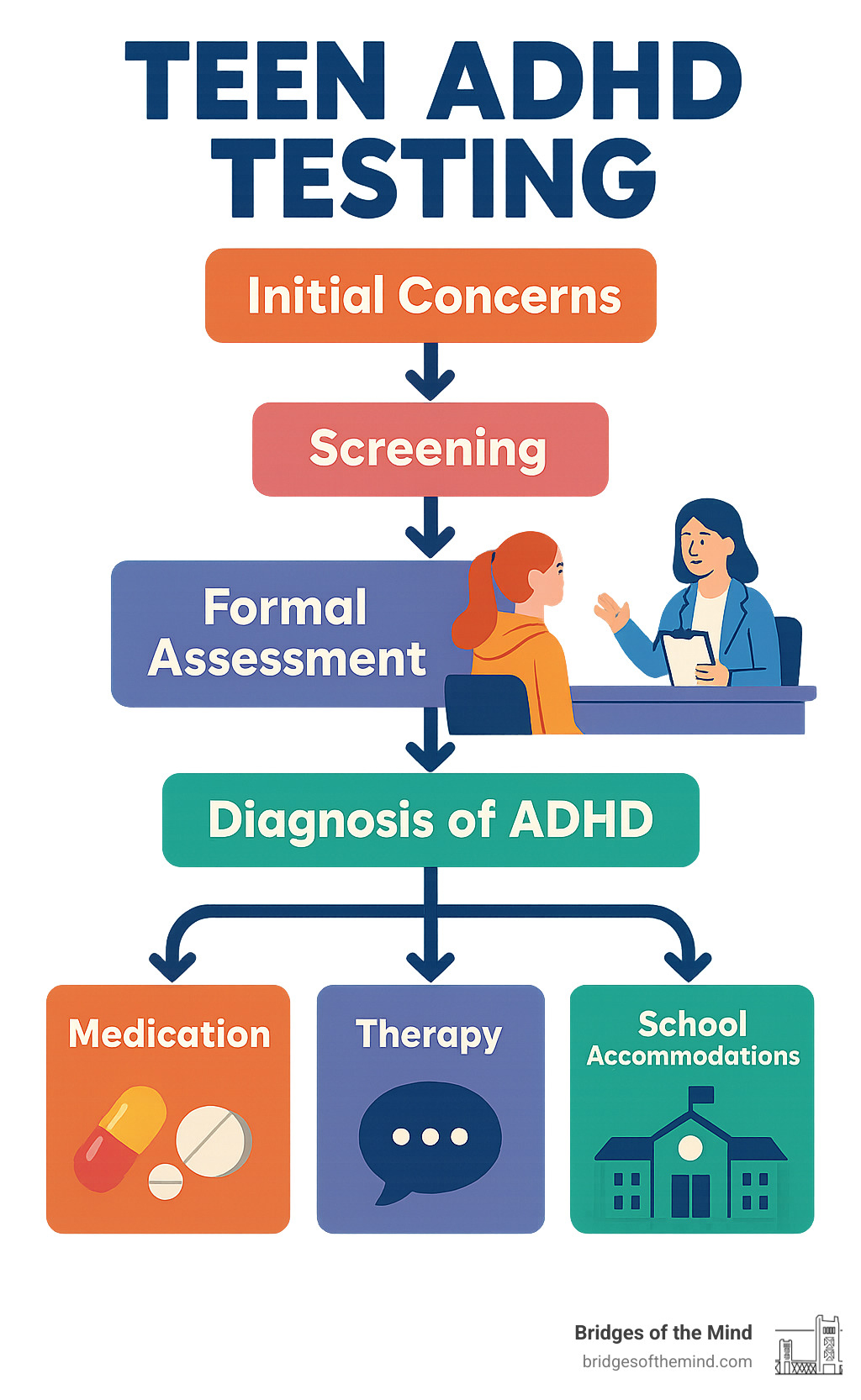
How Teen ADHD Testing Works: Our Step-By-Step Process
At Bridges of the Mind, we want families to know exactly what to expect from the teen ADHD testing journey. Our comprehensive evaluation follows guidelines from the American Psychiatric Association and unfolds through several thoughtful steps designed to capture the full picture of your teen’s experiences.
Initial Consultation
The process begins with a consultation where we gather basic information and determine if a full evaluation makes sense for your situation. We’re not just checking boxes during these conversations—we’re building relationships and creating spaces where teens feel comfortable sharing their genuine experiences, which is essential for an accurate diagnosis.
Clinical Interviews
We conduct detailed interviews with both parents and teens to discuss developmental history, current challenges, and specific concerns you’re noticing at home or school. Family members and other adults who know your teen well provide valuable perspectives that help us understand how symptoms manifest across different environments and relationships.
Standardized Rating Scales
We collect questionnaires completed by parents, teachers, and teens that help quantify ADHD symptoms across different settings. These provide valuable objective data, especially since ADHD symptoms need to appear in multiple environments to meet diagnostic criteria established in the Diagnostic and Statistical Manual.
Cognitive and Neuropsychological Assessments
The heart of teen ADHD testing involves comprehensive assessments that measure attention, executive functioning, memory, processing speed, and academic skills. We also review school records—report cards, standardized test scores, and teacher comments often contain valuable clues about when and how challenges began affecting academic performance.
Physical Health Considerations
We consider physical health factors, including sleep patterns and other biological elements that might impact attention and brain functioning. This multi-informant, multi-method approach follows established guidelines and ensures we’re getting an accurate, comprehensive understanding of your teen’s functioning across different settings.
Feedback and Recommendations
Once testing is complete, we meet for a detailed feedback session where we discuss results, any ADHD diagnosis, and specific recommendations. You’ll receive a comprehensive written report documenting our findings and providing actionable strategies for home, school, and treatment to improve daily functioning.

DSM-5 Criteria & Assessment Standards
For a teen to be ADHD diagnosed, their symptoms must meet specific thresholds outlined in the Diagnostic and Statistical Manual (DSM-5). The Statistical Manual criteria are age-adjusted, recognizing that symptoms often change during development:
For teens under 17, at least six or more symptoms of inattention and/or six or more symptoms of hyperactivity-impulsivity must be present. Once a teen reaches 17, the threshold adjusts to five symptoms in either category. Regardless of age, these symptoms must have been present for at least six months, appear in two or more settings, interfere with daily functioning, and have begun before age 12.
During teen ADHD testing, we use standardized ADHD assessments that help quantify these symptoms objectively. We value the teen’s own perspective when they answer questions about their experiences—teens are often incredibly insightful about their own challenges and might describe feeling constantly overwhelmed by assignments or struggling to initiate certain tasks without realizing these are classic executive functioning difficulties.
These assessments aren’t just about tallying symptoms; they help us understand the specific ways ADHD affects your teen’s daily life, which guides our recommendations for support and helps us treat ADHD effectively.
Types of Assessments & Our Team
At Bridges of the Mind, our ADHD assessments are conducted by licensed mental health professionals with specialized training in neurodevelopmental disorders and mental health conditions. We embrace a neurodiversity-affirmative approach that acknowledges both challenges and strengths associated with different brain wiring.
We’re not just looking for what’s wrong—we’re identifying your teen’s unique cognitive profile, including areas of remarkable strength that can be leveraged as they develop coping strategies with the support of healthcare professionals.
Our assessment tools include:
- Continuous Performance Tests that measure sustained attention and mental effort
- Executive Function Assessments that evaluate planning and organization skills
- Academic Achievement Tests to check for any learning challenges that might affect academic performance
- Intelligence Tests that provide insight into cognitive processing and brain functioning
- Emotional regulation assessments, which are often overlooked but critically important for teens with ADHD who may also experience anxiety or mood disorders
Throughout the entire teen ADHD testing process, our goal remains consistent: to provide clarity, understanding, and a path forward that builds on your teen’s strengths while addressing their challenges with compassion and evidence-based support from trained healthcare providers.
Next Steps After Diagnosis: Treatments & Supports
Receiving an ADHD diagnosis isn’t the end of your family’s journey—it’s the beginning of a path toward better understanding and support. Think of teen ADHD testing as the map that helps guide what comes next for improving mental health and daily functioning.
Many families tell us they feel relief after diagnosis. Finally having a name for what’s been happening allows everyone to move forward with purpose instead of confusion.
Evidence-Based Treatment Options
A comprehensive treatment approach typically combines several elements customized to your teen’s specific needs:
Medication options managed by healthcare providers include stimulants and non-stimulant alternatives that help improve focus and reduce impulsive behaviors for many individuals with ADHD. Some teens may experience trouble sleeping as a side effect, which healthcare professionals can address through timing adjustments or alternative medications.
Behavioral supports make a tremendous difference in helping children with ADHD develop essential skills. Behavior therapy helps teens develop practical skills for planning and organization while addressing negative thought patterns that often develop after years of struggling. Our mental health professionals provide specialized coaching that focuses on building daily life skills—like keeping track of assignments, managing time, and developing social skills—that don’t come naturally to teens with ADHD.
Medication can help level the playing field neurologically, but teens still need to learn the skills and strategies that weren’t automatically developed because of their ADHD. It’s like providing glasses—they can see better, but they still need to learn what to focus on when completing tasks.
School & Home Strategies
The insights from teen ADHD testing should translate into practical strategies for daily life at school and home. Most children with ADHD benefit enormously from having appropriate supports in place across different settings.
At school, formal accommodations through a 504 Plan might include extended time for tests, reduced homework load, or permission to take breaks when focus wanes. For teens with more significant learning impacts, an Individualized Education Program (IEP) provides more comprehensive supports to improve academic performance.
At home, life improves with consistent routines and clear expectations. Rather than nagging, visual reminders and organizational systems help teens develop independence. Technology can be a tremendous ally—calendar apps, task management software, and time-tracking tools all serve as external supports for executive function challenges. Regular exercise can also help manage ADHD symptoms and improve overall mental health.
The goal isn’t to eliminate all challenges—it’s to build skills and systems that allow teens to leverage their strengths while managing their difficulties. We want them to become self-sufficient adults who understand how their brains work and can advocate for their needs with healthcare providers and other adults.
Frequently Asked Questions
Does insurance cover teen ADHD testing?
Insurance coverage varies significantly from one plan to another. Many insurance plans provide partial coverage for psychological evaluations conducted by mental health professionals, but the extent depends on your specific plan benefits, whether you’re working with an in-network provider, and how medical necessity is documented.
We encourage families to contact their insurance company directly before scheduling an evaluation. Ask specifically about coverage for psychological testing for diagnosing ADHD and what documentation they require.
We provide detailed documentation to support insurance claims and can offer superbills for out-of-network reimbursement. We’ve also created transparent fee structures to make teen ADHD testing accessible for families.
How long does the assessment process take?
A comprehensive teen ADHD testing process typically unfolds over several weeks. The actual testing sessions usually total 4-8 hours, divided into 2-3 separate appointments to prevent fatigue and ensure optimal performance when teens answer questions and complete assessments.
Once testing is complete, our mental health professionals need about 1-2 weeks for analysis and report writing. This careful analysis ensures you receive a thorough evaluation rather than rushed conclusions.
From your first appointment to receiving the final report, the entire process typically takes 2-4 weeks. At Bridges of the Mind, we maintain no waitlists for teen ADHD testing. We understand that when families decide to pursue evaluation, they need answers sooner rather than later.
Can ADHD emerge in adolescence?
According to the American Psychiatric Association’s diagnostic criteria, ADHD symptoms must be present before age 12. However, these symptoms may not cause significant problems until the teen years when academic demands increase dramatically, executive function requirements intensify, and supportive structures decrease.
ADHD doesn’t suddenly develop in adolescence, but it’s common for symptoms that were manageable or overlooked in childhood to become problematic during the teen years. This late recognition is particularly common for girls with primarily inattentive symptoms and highly intelligent students who compensated well in elementary school when compared to other children their age.
A thorough evaluation can help determine whether current struggles reflect ADHD that was present but unrecognized earlier, or if other possible causes might be contributing to the challenges affecting mental health and daily functioning.
Why Choose Bridges of the Mind
At Bridges of the Mind Psychological Services, we see teen ADHD testing as the beginning of a journey toward better understanding and support. Our neurodiversity-affirmative approach recognizes that while ADHD presents challenges, it also brings remarkable strengths like creativity, innovative thinking, and passionate interests.
What sets us apart:
- No waitlists – We understand that when families decide to pursue evaluation, they need answers now
- Rapid scheduling – Comprehensive in-person assessments available within 2-3 weeks
- Neurodiversity-affirmative approach – We celebrate differences while addressing challenges
- Comprehensive evaluations – We blend science with compassion in our assessment process
- Personalized recommendations – Practical strategies tailored to your family’s unique circumstances
We serve families throughout Northern California from our location serving Sacramento, South Lake Tahoe, and San Jose. Our comprehensive evaluations include detailed interviews, standardized assessments, and real-world observations. We take time to understand your teen as a whole person, not just a collection of symptoms.
Early identification and customized support can dramatically improve outcomes. With appropriate strategies developed by trained healthcare providers, teens with ADHD can develop effective coping skills, leverage their natural talents, and build confidence that carries into adulthood.
Getting Started
If you’re considering teen ADHD testing, we’re here to provide the clarity and guidance your family deserves. Our team of mental health professionals is ready to help you understand your teen’s unique cognitive profile and develop strategies that build on their strengths while addressing challenges.
The teen years are challenging enough without the added complexity of undiagnosed ADHD or other mental health conditions. Let us help your family build bridges of understanding that can transform struggle into strength and improve daily functioning for your teen.
Contact us today to learn more about our assessment services and take the first step toward supporting your teen’s success and well-being.