
Understanding the reasons for requesting an IEE can feel overwhelming when you’re advocating for your child’s educational needs. As parents navigate the complex world of special education services, many find themselves questioning whether their child’s school evaluation truly captures their unique learning profile.
At Bridges of the Mind Psychological Services, we understand that every child’s neurodiversity presents differently, and we’ve dedicated our practice to providing comprehensive, neurodiverse-affirmative evaluations that honor each child’s individual strengths and challenges. Our team serves families throughout Sacramento, San Jose, and South Lake Tahoe with in-person assessment services designed to provide the clarity you need within 2-3 weeks – no waiting lists, no delays.
Quick Answer: Top Reasons for Requesting an IEE
- You disagree with the school’s evaluation findings
- The school system found no disability, but you suspect one exists
- The school’s evaluation was incomplete or narrow in scope
- Your child isn’t making progress despite having an IEP
- The evaluation methods seem outdated or inappropriate
- You need a more specialized, in-depth assessment
- You want stronger evidence for educational advocacy
Parents often request an independent educational evaluation when they sense that something important has been missed or misunderstood about their child’s learning needs. This parental intuition, combined with legal rights under federal law, provides families with the power to seek comprehensive, unbiased evaluations when school system assessments don’t feel complete.
What is an Independent Educational Evaluation (IEE)?
An independent educational evaluation represents your family’s right to seek a comprehensive assessment from qualified professionals outside the school system. Think of it as obtaining a second opinion – much like seeking a specialist consultation when initial findings don’t align with your observations and concerns.
Under the Individuals with Disabilities Education Act (IDEA), families have the legal right to request an independent educational evaluation IEE at public expense when they disagree with the school district’s evaluation. This protected right ensures that children receive accurate, thorough assessments that truly reflect their educational needs and support their right to a free appropriate public education.
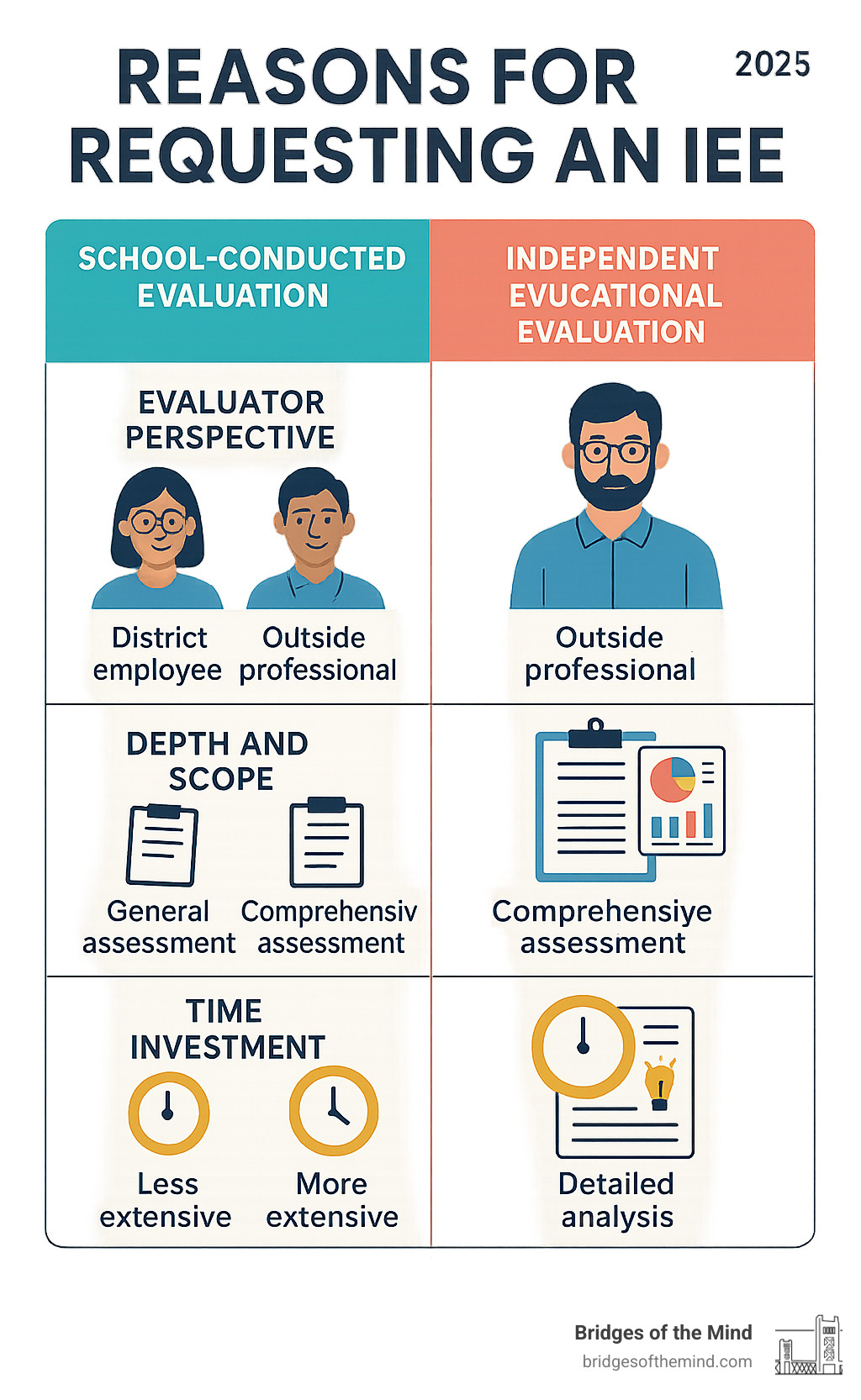
An IEE at public expense differs significantly from typical school evaluations in several important ways. Independent evaluators bring fresh perspectives without the budget constraints or time limitations that often affect school system assessments. We can dedicate the necessary time to explore all aspects of your child’s learning profile, using current assessment tools and evidence-based methodologies.
Our comprehensive assessment services at Bridges of the Mind focus entirely on understanding your child’s unique neurodiversity. We don’t approach evaluations with preconceived notions about what “normal” should look like. Instead, we celebrate neurodivergent thinking patterns while identifying specific areas where targeted support could make a meaningful difference in your child’s education.
The beauty of having your child evaluated independently lies in its personalized approach. While school system evaluations often follow standardized protocols designed for efficiency, we tailor our assessment process to your child’s specific presentation, interests, and learning style. This individualized methodology ensures that we capture subtle nuances that broader assessments might miss.
Understanding Your Legal Rights Under IDEA
Federal law provides families with specific protections designed to ensure children receive appropriate special education services. The Individuals with Disabilities Education Act establishes clear guidelines about when and how parents can request an independent educational evaluation at public expense, creating a framework that prioritizes child advocacy over institutional convenience.
Your right to disagree with school evaluation findings forms the foundation of IEE protections. When a parent disagrees with the school district’s assessment, you don’t need to provide detailed explanations or justifications for your concerns – your parental observations and intuition carry legal weight in this process. When you formally request an IEE at public expense, the school system must respond within reasonable timeframes, typically 15 school days.
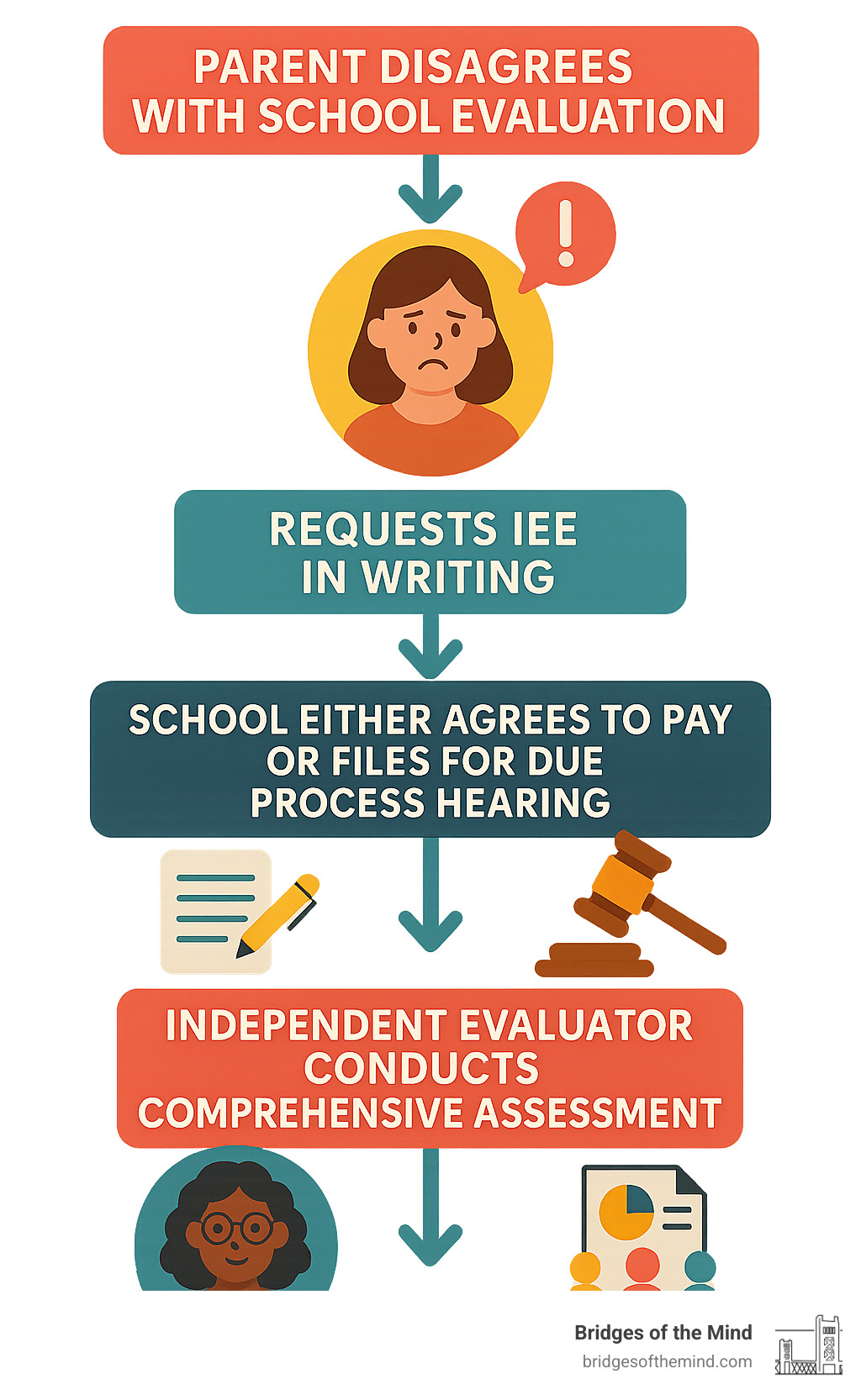
School districts have exactly two options when you request an independent educational evaluation at public expense. They can agree to fund the evaluation and provide information about qualified examiners, or they can initiate a due process hearing to defend their original evaluation. During a due process hearing, a hearing officer decides whether the school district’s original assessment was appropriate. They cannot simply refuse your request or create unreasonable delays in the process.
The school system pays for the independent educational evaluation when your request is approved, removing financial barriers that might prevent families from seeking additional assessment. This provision ensures that economic circumstances don’t limit a child’s access to comprehensive evaluation when the school district’s original assessment is questioned.
Understanding these rights empowers families to advocate effectively for their children. At Bridges of the Mind, we’ve worked with numerous families navigating this process, and we’re familiar with the district’s criteria and specific requirements that make IEE requests successful. Our team can provide guidance about the formal request process while focusing on delivering comprehensive evaluations that meet all legal standards.
The IEE Request Process: Formal Steps
Making a formal request for an independent educational evaluation requires specific written documentation. Your written request should include your complete contact information: your street address, city, zip code, and daytime telephone number. You’ll also need to include the school’s complete information, including the school street address, city, and zip code.
When you request an independent educational evaluation, clearly state that you are seeking this evaluation conducted at public expense. The school system must either agree to pay for the evaluation or file for a due process hearing to prove their original assessment was comprehensive and appropriate.
If the school district agrees to your request, they’ll provide information about their criteria for qualified examiners and any procedural requirements. This ensures that your chosen evaluator meets the same criteria used by the school system and that the results will be properly considered by your child’s IEP team.
Should the school district choose to defend their evaluation through due process, remember that the burden of proof lies with them, not with your family. A hearing officer will review all evidence and decide whether the original evaluation was adequate. Even during this process, you can still have your child evaluated independently at your own expense.

Top 7 Reasons for Requesting an IEE
1. You Disagree with the School’s Evaluation Findings
The most common reason families seek an independent educational evaluation stems from fundamental disagreement with school assessment results. When evaluation reports don’t align with your daily observations of your child’s learning challenges or strengths, trusting your parental instincts becomes crucial.
Perhaps the school system concludes that your child performs at grade level, yet you witness nightly homework struggles that seem disproportionate to the assigned tasks. Maybe they’ve identified a disability classification that doesn’t match your child’s actual presentation, or they’ve determined no disability exists despite clear signs that your child needs additional tests and support.
Our neurodiverse-affirmative approach recognizes that traditional evaluation methods sometimes miss important aspects of how children process information and engage with learning. We use comprehensive assessment tools that explore multiple facets of cognitive functioning, executive skills, and academic processing to provide a complete picture of your child’s learning profile and accurately describe their educational needs.
The legal framework supporting your right to disagree acknowledges that parents possess unique insights about their children’s functioning across different environments and situations. You observe your child’s responses to various challenges, their coping strategies, and their emotional reactions to academic demands – observations that brief school evaluations might not capture.
2. The School System Found No Disability, But You Suspect One
School evaluations sometimes conclude that children don’t require special education services, despite ongoing concerns about learning, behavior, or social-emotional functioning. This situation occurs frequently, particularly with conditions that present subtly or differently than commonly expected patterns.
High-functioning autism, especially in girls, often goes unrecognized in school system settings where masking behaviors can make challenges less obvious. ADHD presentations vary significantly among children, and inattentive types may not display the hyperactive behaviors that school staff typically associate with attention difficulties.
Twice-exceptional students – those who are both gifted and have learning disabilities – present particularly complex profiles that standard school evaluations may struggle to identify. These children often compensate for their learning differences through superior intellectual abilities, making their challenges nearly invisible in traditional academic settings.
When you have your child evaluated independently, our ADHD testing and evaluations in Sacramento use current diagnostic criteria and comprehensive assessment protocols that explore attention, executive functioning, and behavioral regulation across multiple domains. Similarly, our autism testing and evaluations employ gold-standard diagnostic tools designed to identify autism spectrum presentations across diverse populations and age groups.
We understand that anxiety, trauma responses, and emotional regulation difficulties can significantly impact learning and academic performance in ways that aren’t always obvious during brief school system assessments. Our psychological assessment approach considers the complex interplay between cognitive abilities, emotional functioning, and academic performance.
3. The School’s Evaluation Was Incomplete
Federal regulations require that children be tested in all areas of suspected disability, but school assessments sometimes focus narrowly on academic achievement while overlooking important underlying factors that affect learning and your child’s free appropriate public education.
Incomplete evaluations might assess reading skills without exploring the visual processing abilities, working memory capacity, or attention factors that influence reading comprehension. They might examine mathematical performance without considering spatial reasoning, executive functioning, or the fine motor skills that affect written calculation.
Our comprehensive approach to learning disability evaluations ensures that we examine all relevant domains that could impact your child’s educational experience. We explore cognitive processing strengths and challenges, academic skill development, executive functioning, social-emotional factors, and any behavioral considerations that might affect learning and your child’s individualized education program.
Sometimes school evaluations miss important areas like speech and language development, occupational therapy needs, or assistive technology requirements that could significantly improve your child’s educational access. When necessary, we coordinate with specialists across disciplines and may recommend additional academic tests when comprehensive evaluation requires multiple perspectives.
The goal of thorough evaluation extends beyond identifying eligibility for special education services – we aim to understand how your child learns best, what accommodations might enhance their success, and what intervention approaches align with their unique neurodivergent profile.
4. Your Child Isn’t Making Progress Despite an IEP
When children receive special education services but continue struggling academically, socially, or behaviorally, it often indicates that the original evaluation missed important aspects of their learning profile or that their needs have evolved since the initial assessment by the school system.
Lack of meaningful progress despite targeted interventions suggests that current support strategies may not align with your child’s actual learning style or that additional challenges require identification and intervention. Sometimes children develop new coping mechanisms that mask underlying difficulties, making it appear that they’re managing when they’re actually working much harder than necessary.
Educational demands change as children advance through grade levels, and learning differences that weren’t problematic in earlier years may become more significant as academic complexity increases. Executive functioning challenges, for example, often become more apparent in middle and high school when organizational demands intensify and your child’s IEP may need significant revisions.
Our assessment services for teens recognize the unique developmental factors that affect adolescent learning and provide age-appropriate evaluation approaches that consider increasing independence expectations, social pressures, and identity development alongside academic functioning.
When we conduct an evaluation, we examine why current interventions aren’t producing expected results and identify alternative approaches that might better match your child’s learning profile. Sometimes this involves recognizing additional areas of challenge that weren’t addressed in the original evaluation, or identifying strengths that could be leveraged more effectively.
5. The Evaluation Methods or Tools Seem Outdated or Inappropriate
Assessment quality depends heavily on using current, evidence-based tools administered by qualified examiners with appropriate expertise for the suspected areas of concern. Sometimes school system evaluations rely on outdated instruments that don’t reflect our current understanding of learning differences and neurodiversity.
Cultural responsiveness in evaluation represents another crucial consideration. Assessment tools and interpretation approaches must account for linguistic diversity, including evaluation in your child’s native language when appropriate, cultural background, and individual presentation patterns to provide accurate results. What might appear to be a learning disability could actually reflect cultural or linguistic differences that require different support approaches.
Qualified examiner credentials matter significantly in producing accurate, useful results. Assessing complex conditions like autism spectrum disorder or specific learning disabilities requires specialized training and experience that not all evaluators possess. Our team maintains current expertise in neurodiversity assessment and uses evaluation tools that reflect the latest research in the field, ensuring we meet the same criteria for professional standards as required by school districts.
We ensure that our assessment approaches accommodate individual presentation patterns and learning styles. Some children require extended time, frequent breaks, or alternative response formats to demonstrate their true abilities. Others may need evaluations conducted over multiple sessions to reduce fatigue and anxiety effects, ensuring accurate results that support their educational needs.
6. You Need a More In-Depth, Specialized Assessment
Some children require more comprehensive evaluation than typical school assessments provide. This might include neuropsychological evaluation for complex learning profiles, assessment of co-occurring conditions, or evaluation approaches designed specifically for twice-exceptional students who need specialized understanding of their unique combination of gifts and challenges.
Autism spectrum evaluations often require specialized diagnostic tools and observation protocols that go well beyond standard school system assessments. Our autism testing uses comprehensive diagnostic approaches that examine social communication, behavioral patterns, sensory processing, and adaptive functioning across multiple environments.
Children with trauma histories may require evaluation approaches that account for how traumatic experiences affect learning, attention, memory, and emotional regulation. Traditional assessment methods may not capture the full impact of trauma on educational functioning or may inadvertently re-traumatize children during the evaluation process.
Our assessment services for adults recognize that many individuals seek evaluation later in life when they begin to understand patterns in their learning, work performance, or relationships that suggest neurodivergent traits. Adult evaluation requires different approaches that account for developed coping strategies and life experiences while maintaining the thoroughness needed for accurate diagnosis.
When you have your child tested through our independent evaluation process, we ensure that all aspects of their learning profile receive appropriate attention, providing the comprehensive understanding needed to support their educational success.
7. To Gather Stronger Evidence for Advocacy
Sometimes families need comprehensive documentation to advocate effectively for appropriate special education services, accommodations, or educational placements. An independent educational evaluation can provide detailed recommendations, expert opinions, and professional documentation that strengthens your position when working with school systems.
Strong evaluation reports include specific intervention recommendations, accommodation suggestions, and clear explanations of how identified challenges affect educational functioning and your child’s education. This documentation becomes particularly important when requesting specific services, classroom modifications, or specialized programming through your child’s IEP.
Due process proceedings, mediation sessions, and IEP meetings all benefit from having comprehensive, professionally conducted evaluations that clearly articulate your child’s needs and appropriate intervention approaches. Independent testing carries particular weight because it represents unbiased professional opinions focused solely on your child’s needs rather than budget considerations.
Our evaluation reports provide detailed explanations of findings, clear connections between identified challenges and educational impacts, and specific recommendations for interventions, accommodations, and support strategies. We write reports that families can use effectively in advocacy while ensuring that recommendations are practical and implementable within school system frameworks.
How School Districts Respond to IEE Requests
When you formally request an independent educational evaluation at public expense, the school district must respond without unreasonable delays, typically within 15 school days. They cannot ignore your request or create barriers to prevent you from exercising your legal rights.
The school system has exactly two legal options when you request an IEE at public expense. First, they can agree to fund the evaluation and provide you with information about their criteria for qualified examiners. This includes any requirements about evaluator qualifications, geographic limitations, or procedural standards that must be met.
Second, the school district can initiate a due process hearing to defend their original evaluation. If they choose this path, they must prove to a hearing officer that their assessment was comprehensive, appropriate, and followed all required procedures. The hearing officer decides whether the school’s evaluation met legal standards, and if it didn’t, the school system pays for your requested independent evaluation.
What school districts cannot do is equally important to understand. They cannot simply refuse your request without filing for due process. They cannot require you to explain in detail why you disagree with their findings, though providing context can be helpful. They cannot impose unreasonable conditions or limit you to only their preferred evaluators, as long as your chosen professional meets basic qualifications.
If the hearing officer decides that the school district’s original evaluation was appropriate, you can still obtain an independent evaluation at your own expense. The school system must still consider these results when making decisions about your child’s education, even when they don’t pay for the assessment.
How IEE Results Impact Your Child’s Education
Independent evaluation results become part of your child’s educational record and must be considered by the IEP team when making decisions about programming and special education services. “Considered” has specific meaning in special education law – the team must review and discuss the findings during IEP meetings, though they aren’t required to implement every recommendation.
Strong IEE results provide detailed explanations of your child’s learning profile, specific recommendations for interventions and accommodations, and clear connections between identified challenges and educational impacts. This documentation helps IEP teams understand not just what your child needs, but why specific supports are necessary for their free appropriate public education.
The evaluation findings can inform IEP goal development, service determination, and accommodation planning. When recommendations are based on comprehensive assessment and professional expertise, school systems are more likely to provide appropriate supports and services that truly meet your child’s needs.
Independent evaluations also serve as valuable documentation for future advocacy efforts. As your child advances through different grade levels and educational environments, having comprehensive assessment information helps ensure continuity of appropriate support and maintains focus on their individualized educational needs.
When disagreements arise about services or placements, having a thorough independent evaluation strengthens your position in mediation or due process proceedings. Hearing officers and mediators give significant weight to comprehensive, professionally conducted assessments that clearly document a child’s needs and appropriate interventions.
Working with Bridges of the Mind for Your IEE
Our evaluation process begins with understanding your specific concerns and questions about your child’s learning profile. We recognize that when families seek an independent educational evaluation, they’re often frustrated with previous assessment experiences and need evaluators who truly understand neurodiversity.
We maintain no waiting lists, recognizing that when families have concerns about their child’s educational needs, timely assessment is crucial. Most families can schedule their comprehensive evaluation within 2-3 weeks of initial contact, allowing you to move forward with advocacy and planning without extended delays that many school systems impose.
Our neurodiverse-affirmative approach means that we don’t view learning differences as deficits to correct, but rather as natural variations in human neurology that require understanding and appropriate support. This perspective influences every aspect of our evaluation process, from the tools we use to how we interpret and report results.
When the school system conducts an evaluation that doesn’t capture your child’s full profile, our independent assessment provides the comprehensive understanding needed for effective advocacy. We examine all relevant domains of functioning and provide detailed recommendations that support your child’s right to appropriate special education services.
Our team serves families throughout Sacramento, San Jose, and South Lake Tahoe with in-person evaluation services that maintain the highest professional standards while creating comfortable, supportive environments for children and families. We work primarily with self-pay families who value comprehensive, timely assessment without the limitations often imposed by insurance requirements or school system constraints.

Taking Action: Moving Forward with Confidence
Recognizing that your child may need an independent educational evaluation represents an important step in educational advocacy. Your parental instincts about your child’s learning needs deserve professional attention, and you have legal rights designed to ensure that appropriate assessment occurs when you disagree with school system findings.
The process of requesting an IEE at public expense provides families with powerful tools for advocacy, but it requires understanding your rights and following proper procedures. Whether the school system pays for your evaluation or you choose to fund it independently, having comprehensive assessment information strengthens your ability to advocate effectively for your child’s needs.
At Bridges of the Mind Psychological Services, we’re committed to providing thorough, neurodiverse-affirmative evaluations that honor your child’s unique strengths while identifying areas where targeted support could make a meaningful difference. Our comprehensive assessment services for children, teens, and adults are designed to provide the detailed information families need for effective advocacy within school systems.
We understand that seeking an independent evaluation can feel overwhelming, especially when you’re already concerned about your child’s educational experience and may have had frustrating interactions with school staff. That’s why we’ve eliminated waiting lists and streamlined our scheduling process to provide assessments within 2-3 weeks of initial contact.
Every child deserves to have their learning differences understood and appropriately supported through comprehensive special education services when needed. When school evaluations don’t provide the complete picture you need for effective advocacy, an independent educational evaluation can provide the professional documentation and recommendations necessary to ensure your child receives appropriate educational support.
Contact us today to learn more about our comprehensive assessment services and how we can help your family navigate the path toward educational success. Your child’s unique neurodiversity is a strength to be understood and supported, not a challenge to be minimized or overlooked by school systems that may not fully appreciate their individual needs.