
Understanding Why Learning Disability Evaluations Matter
If you’re wondering how to get evaluated for learning disability, you’re taking a crucial and empowering first step. Many parents and individuals in the Sacramento, San Jose, and South Lake Tahoe areas feel lost about where to begin, often after months or years of unexplained academic struggles. Parents frequently notice their child struggling compared to other children, which prompts them to seek answers. The evaluation process, however, is manageable and incredibly worthwhile, offering clarity and a path forward.
Learning disabilities are brain-based differences in how people receive, process, store, and respond to information. These learning disorders are neurological in origin and are not related to a person’s intelligence. In fact, individuals with learning disabilities possess average to superior intelligence. Learning disabilities are common among school aged children, and early identification is crucial for effective support. With a proper, thorough evaluation and personalized support, children and adults can unlock their potential and thrive academically, professionally, and personally.
A comprehensive evaluation provides a detailed roadmap for understanding a unique learning profile. It moves beyond simple labels to explain why certain tasks are challenging and, just as importantly, to identify areas of significant strength. Assessment tools used in these evaluations help professionals gather information about a child’s learning patterns and abilities. At Bridges of the Mind Psychological Services, we specialize in these comprehensive assessments. Using a neurodiversity-affirming approach, our team has seen how the right evaluation can transform a person’s educational journey, boost self-esteem, and foster profound self-understanding.
Quick Steps to an Evaluation
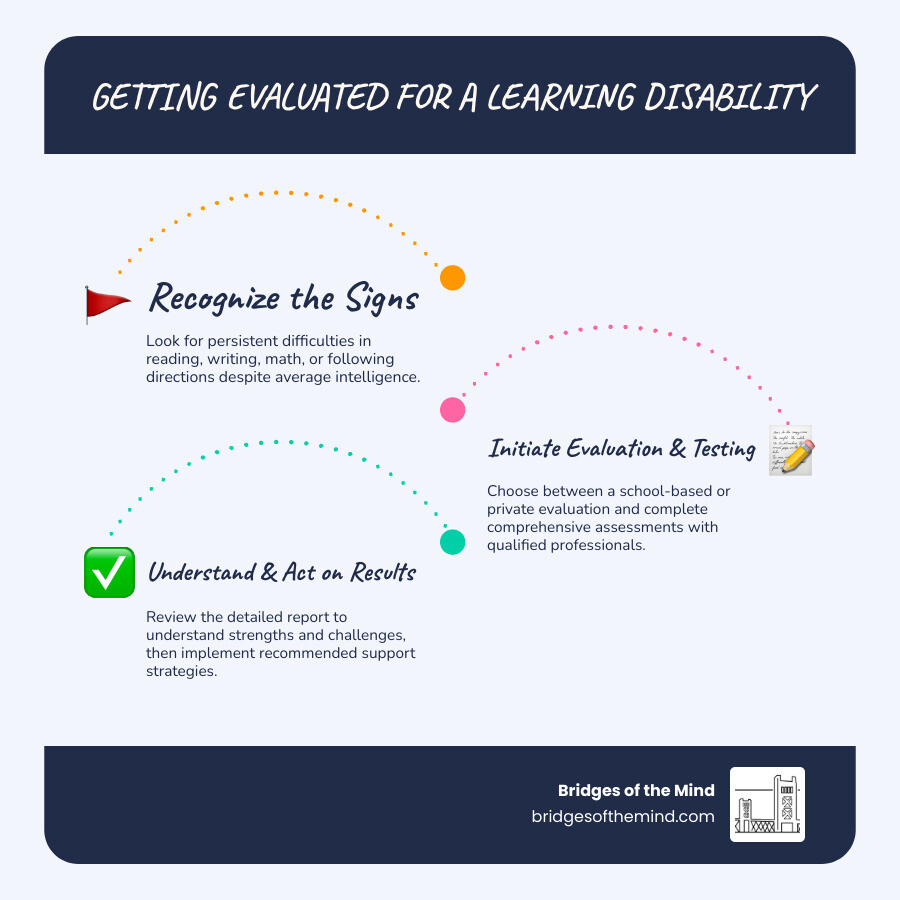
- Recognize early signs of persistent academic struggles that don’t align with overall intelligence
- Choose your path: a free evaluation through the public school system (for K-12 students) or a private evaluation with qualified professionals
- Find qualified professionals such as clinical psychologists or neuropsychologists who specialize in learning and brain function
- Complete comprehensive testing using standardized tests to assess cognitive and academic skills
- Review the detailed report in a feedback session to understand findings, strengths, challenges, and formal diagnosis if applicable
- Implement support by using the report to advocate for accommodations, interventions, and strategies
Recognizing the Signs: When to Consider an Evaluation
Parental instinct is powerful, as is an adult’s self-awareness. Parents often notice when their child’s progress doesn’t match expectations for their grade level or when differences become apparent compared to other kids. If you observe persistent struggles that seem out of sync with your child’s (or your own) intelligence and effort, it might be time to consider evaluation. The key is persistence—we’re not talking about occasional homework battles or a tough week, but ongoing challenges that don’t improve with extra help, tutoring, or determination.
Many children may show occasional difficulties, but when a child continues to struggle despite interventions, it’s important to seek professional assessment. Understanding a child’s strengths and learning patterns becomes crucial for their educational success.
When Signs First Appear: From Preschool Through High School
Preschool Years:
- Trouble learning the alphabet, simple words, or days of the week
- Difficulty recognizing letters in their own name
- Challenges with fine motor skills like holding a crayon or using scissors
- Difficulty following multi-step directions or retelling simple stories
- Significant speech delays compared to other children
Elementary School (Including First Grade):
- Slow, effortful reading and frequent guessing at simple words
- Significant difficulty with spelling, grammar, and written expression
- Struggles with math concepts, math problems, or understanding math symbols
- Messy, illegible handwriting and trouble spacing words
- Difficulty remembering facts, dates, or instructions
- Disorganization, frequently losing homework or belongings
- First grade is often when learning disabilities become noticeable in a child’s learning
Teenage Years:
- Difficulty with reading comprehension of complex texts
- Overwhelming challenges organizing and writing essays or reports
- Struggles with abstract math concepts like algebra
- Poor time management and difficulty planning projects
- Actively avoiding reading or writing tasks
- Trouble interpreting social cues or understanding sarcasm
Common Types of Learning Disabilities
Learning disabilities are brain-based processing differences, not intellectual deficits. The Diagnostic and Statistical Manual provides classifications for these specific learning disabilities. At Bridges of the Mind, our neurodiverse-affirmative approach celebrates these differences as natural human variation while providing practical support to navigate challenges.
Dyslexia: A specific learning disability in reading that primarily affects language processing skills, especially phonological awareness. Signs include slow reading, poor spelling, and difficulty decoding unfamiliar words.
Dysgraphia: A specific learning disability affecting written language that can manifest as illegible handwriting, awkward pencil grip, inconsistent spacing, or significant difficulty organizing thoughts in written expression.
Dyscalculia: A specific learning disability in mathematics. Individuals may struggle with number sense, memorizing basic math facts, understanding quantities, or grasping abstract mathematical concepts when solving math problems.
Non-Verbal Learning Disabilities (NVLD): Involves challenges with visual-spatial reasoning, organization, and social cognition, despite often having strong verbal and memory skills.
Auditory Processing Disorder (APD): Affects how the brain interprets sounds, leading to difficulty understanding speech in noisy environments or following verbal instructions.
Visual Processing Disorder (VPD): Impacts how the brain makes sense of visual information, causing trouble distinguishing similar letters, copying from boards, or judging distances.

How to Get Evaluated for a Learning Disability: Understanding Your Options
When you’re ready to pursue an evaluation, you have two main options: the public school system or private evaluation. Both aim to identify learning differences, but they differ significantly in timeline, scope, and outcome. Understanding evaluation procedures helps parents make informed decisions about their child’s educational future.
Path 1: The School System Evaluation
Public school systems are legally required under the Individuals with Disabilities Education Act (IDEA) to identify and evaluate students with suspected disabilities at no cost to families. The nation’s special education law mandates that school districts provide comprehensive assessments for children who may need special education services.
Initial Evaluation Process: The evaluation procedures begin when parents submit a formal, dated letter to the school district requesting a comprehensive evaluation for a suspected learning disability. IDEA requires schools to respond promptly to these requests.
Response to Intervention (RTI): Before a full evaluation, the school may implement research based intervention and academic support while monitoring the child’s progress. If these interventions don’t resolve struggles, the school must proceed with evaluation. However, IDEA states that RTI cannot be the sole criterion for identifying specific learning disabilities.
The Evaluation Team: A multidisciplinary team typically includes a school psychologist, special education teacher, general education teacher, and the child’s teacher. This team works together to gather information about the child’s learning and assess their educational needs. Federal law typically gives school districts 60 days to complete this process.
Related Services and Educational Programming: If the child evaluated qualifies, the team creates an Individualized Education Program (IEP) that may include related services such as speech therapy or occupational therapy. Educational programming decisions are based on the child’s evaluation results and focus on the child’s educational needs.
Legal Rights and Due Process: Parents have legal rights throughout this process, including the right to request an independent evaluation if they disagree with the school district’s findings. If disputes arise, parents may request a due process hearing where a hearing officer makes determinations about the child’s educational needs.
School evaluations are free but can be lengthy and focus strictly on educational eligibility for special education services, not clinical diagnosis.
Path 2: Seeking a Private Evaluation
Many parents choose private evaluation for several key advantages. At Bridges of the Mind, we offer:
No Waitlists & Faster Answers: While school systems can take months for initial evaluation and to complete the process, we can typically schedule comprehensive, in-person assessments within 2-3 weeks. This means faster answers, quicker access to support, and less time struggling.
Comprehensive Scope & Clinical Diagnosis: Our evaluations explore cognitive functioning, memory, attention, executive functions, and social-emotional processing for a complete picture. We administer tests that provide detailed information about intelligence quotient and academic performance. The outcome is a clinical diagnosis that can be used for school support, college accommodations, and workplace advocacy.
Neurodiverse Affirmative Approach: We focus on identifying and celebrating unique brain wiring and cognitive strengths. Our goal is helping parents understand how their child’s brain works best, providing a positive and empowering framework for moving forward.

Special Considerations for Different Educational Settings
Public School vs. Private School
While public school students have extensive protections under IDEA regulations, private school students have different rights and procedures. Parents of children in private schools should understand both federal law requirements and state law variations when seeking evaluations.
Additional Legal Protections
Beyond the Individuals with Disabilities Education Act, other laws like the Rehabilitation Act provide protections for students. Section 504 of the Rehabilitation Act ensures that children with disabilities receive appropriate accommodations even if they don’t qualify for special education services.
Evaluation as an Adult
Learning disorders don’t disappear after graduation. Many adults grapple with undiagnosed learning differences that impact their careers, higher education, and daily life. Adults seeking evaluation often need documentation for workplace accommodations or higher education support.
Common Adult Challenges:
- Difficulty meeting deadlines or organizing complex projects
- Trouble with written language in professional settings
- Challenges with academic performance in continuing education
- Struggles with processing information quickly in work environments
Our assessment services for adults provide the clarity and documentation needed for effective self-advocacy in various settings.

Understanding the Evaluation: Assessment Tools and Testing
Getting evaluated for learning disability involves comprehensive, multi-faceted assessment. At Bridges of the Mind, we approach each evaluation with respect for neurodiversity. Our goal is understanding how an individual’s brain processes information to provide a clear roadmap for leveraging strengths and supporting challenges.
Cognitive and Intelligence Testing
Standardized tests help us understand how a person thinks, reasons, solves problems, and processes information. These assessment tools measure specific cognitive abilities like verbal reasoning, visual-spatial skills, fluid reasoning, working memory, and processing speed. Intelligence quotient testing provides a detailed profile that distinguishes learning disabilities from other conditions.
Academic Achievement Testing
While cognitive tests reveal potential, academic achievement tests measure what a person has actually learned in core academic areas. These assessments evaluate skills in reading, written language, and mathematics. A significant gap between cognitive potential and academic performance is a hallmark of specific learning disabilities.
Comprehensive Assessment Approach
Our evaluation procedures include multiple assessment tools to ensure accurate diagnosis. We gather information from various sources, including parents, teachers, and the individuals themselves. This comprehensive approach helps us understand the full scope of a person’s learning profile.
After the Diagnosis: Next Steps and Support
Receiving the evaluation report is the beginning of a new, more informed chapter. At Bridges of the Mind, we present findings from a strengths-based, neurodiverse affirmative perspective. During detailed feedback sessions, our team walks parents and individuals through results, ensuring they understand the conclusions while focusing on inherent strengths.
Understanding Your Child’s Evaluation Results
The child’s evaluation provides a practical roadmap for personalized support. We help parents understand their child’s strengths and areas where additional support may be needed. The report clearly differentiates between accommodations and modifications based on the child’s specific learning profile.
Examples of Accommodations:
- Extended time on standardized tests
- Use of calculators or audiobooks
- Preferential seating away from distractions
- Speech-to-text software for written expression
- Access to teacher’s notes
Examples of Modifications:
- Simplified curriculum or fewer math problems
- Alternative assignments
- Different grading standards
Using the Results Effectively
The diagnostic report serves as your primary advocacy tool, providing detailed test scores, formal diagnosis, and evidence-based recommendations. When discussing the diagnosis with your child, frame it as learning about their unique brain and celebrate their individual strengths.
Building a Support System
A diagnosis is a starting point. Building a robust, collaborative support system is vital for long-term success. This often involves working closely with your child’s teacher and school personnel to implement appropriate supports.
Collaborate with Educational Teams: Schedule meetings to share relevant report sections with your child’s teacher and school psychologist. Work together to implement recommended accommodations and create supportive environments that address your child’s learning needs.
Find Educational Therapists: Seek professionals trained in research based intervention methods. Unlike regular tutors who re-teach content, educational therapists teach strategies on how to learn more effectively.
Connect with Support Networks: Organizations like the Learning Disabilities Association provide invaluable emotional support and practical advice from other parents on similar journeys.
Empower Self-Advocacy: Help your child understand their learning style, practice asking for help, and focus on strengths to build resilience and confidence in their academic journey.
Frequently Asked Questions
What role do parents play in the evaluation process?
Parents are crucial partners throughout the evaluation process. Parents understand their child’s development, challenges, and strengths better than anyone. School districts and private evaluators rely on parents to gather information about the child’s history, current difficulties, and family concerns. Parents also have legal rights to participate in decisions about their child’s educational programming and can request additional resources when needed.
How do evaluation procedures differ between settings?
Evaluation procedures vary between public school systems and private settings. School districts must follow IDEA regulations and state law requirements, focusing primarily on educational eligibility for special education services. Private evaluations often provide more comprehensive assessment using additional standardized tests and may result in clinical diagnoses that extend beyond educational settings.
What happens if my child continues to struggle after evaluation?
If a child continues to experience difficulties despite interventions, parents can request additional evaluation or seek more resources. The evaluation team may need to reassess the child’s progress and modify educational programming accordingly. Sometimes children require ongoing support and adjustments to their learning environment.
Can learning disabilities be identified in first grade?
Yes, learning disabilities can often be identified in first grade when children are expected to master foundational academic skills. Many children show early signs in kindergarten and first grade, particularly with reading simple words, understanding math symbols, or developing written expression skills. Early identification allows for prompt intervention and support.
Understanding Legal Rights and Protections
IDEA Requirements and Regulations
The Individuals with Disabilities Education Act provides comprehensive protections for children with disabilities. IDEA requires schools to use multiple assessment tools and follow specific evaluation procedures. School districts must ensure that children receive appropriate special education services when needed and that parents understand their legal rights throughout the process.
State Law Variations
While federal law provides baseline protections, state law may offer additional requirements or protections. Parents should understand both federal and state requirements when navigating the evaluation process and advocating for their child’s educational needs.
Due Process Protections
If parents disagree with evaluation results or educational programming decisions, they have the right to request a due process hearing. A hearing officer will review the case and make determinations about appropriate services and supports for the child.
Conclusion
Understanding how to get evaluated for learning disability is the first, most powerful step toward unlocking your child’s full potential. The evaluation process moves beyond frustration of the unknown and provides invaluable insights into unique learning profiles, clearly identifying specific strengths alongside challenges.
Learning disorders are simply brain-based processing differences, not reflections of intelligence, effort, or worth. They represent different ways of learning that require different approaches to teaching and support. Many children with learning disabilities go on to achieve remarkable success when they receive appropriate support and understanding.
At Bridges of the Mind, we know that waiting for answers is not an option when a child is struggling daily. That’s why our team is committed to providing comprehensive, in-person assessments with no waitlists. We can typically schedule full evaluations within 2-3 weeks, allowing parents to get clarity and move forward with concrete plans quickly.
Our neurodiverse affirmative approach is at the heart of everything we do. We celebrate the unique ways different brains work and are dedicated to helping parents understand, support, and empower their children. Whether you’re a parent seeking help for your child, a young adult needing accommodations, or an adult on your own journey of self-discovery, our team is here to guide you.
Ready to take the next step? Contact us today to learn about our assessment services and how we can support your child’s learning journey. Your path toward understanding and empowerment begins now.