
Why Adult Learning Disability Testing Changes Everything
Adult learning disability testing opens the door to answers for millions of adults who have struggled with learning difficulties their entire lives. If you’re reading this, you might be one of the approximately 10-15% of adults affected by learning disabilities—many of whom remain undiagnosed well into adulthood, silently questioning their own capabilities. This journey of uncertainty can take a significant toll, impacting careers, relationships, and self-esteem.
At Bridges of the Mind Psychological Services, we provide comprehensive psychological evaluations conducted at our Sacramento clinic. We serve adults from across Northern California, including those traveling from San Jose and South Lake Tahoe, who value a neurodiversity-affirming, highly personalized evaluation. We have no waiting lists and can typically schedule a comprehensive assessment within 2-3 weeks.
We are a self-pay practice with limited insurance acceptance—Kaiser members may be seen through our Autism Clinic. Please contact us for current availability, scheduling, and fee information.
Understanding Adult Learning Disability Testing
What Comprehensive Assessment Involves
Learning disability testing is not a simple quiz or screening. It’s a comprehensive, personalized evaluation conducted by our qualified psychological professionals to assess your unique cognitive profile. The assessment process examines cognitive abilities, academic skills, information processing, and memory to identify specific learning disabilities like dyslexia, dysgraphia, or dyscalculia. We also consider co-occurring factors such as attention deficit disorders or mental health concerns that may influence learning.
Our Specialized Team
To ensure an accurate diagnosis and meaningful results, disability testing is performed by our licensed psychological professionals with specialized training in learning disorders and differential diagnosis. We take a neurodiversity-affirming approach that highlights strengths as much as challenges, celebrating the unique ways your mind processes information.
Time Investment and Process
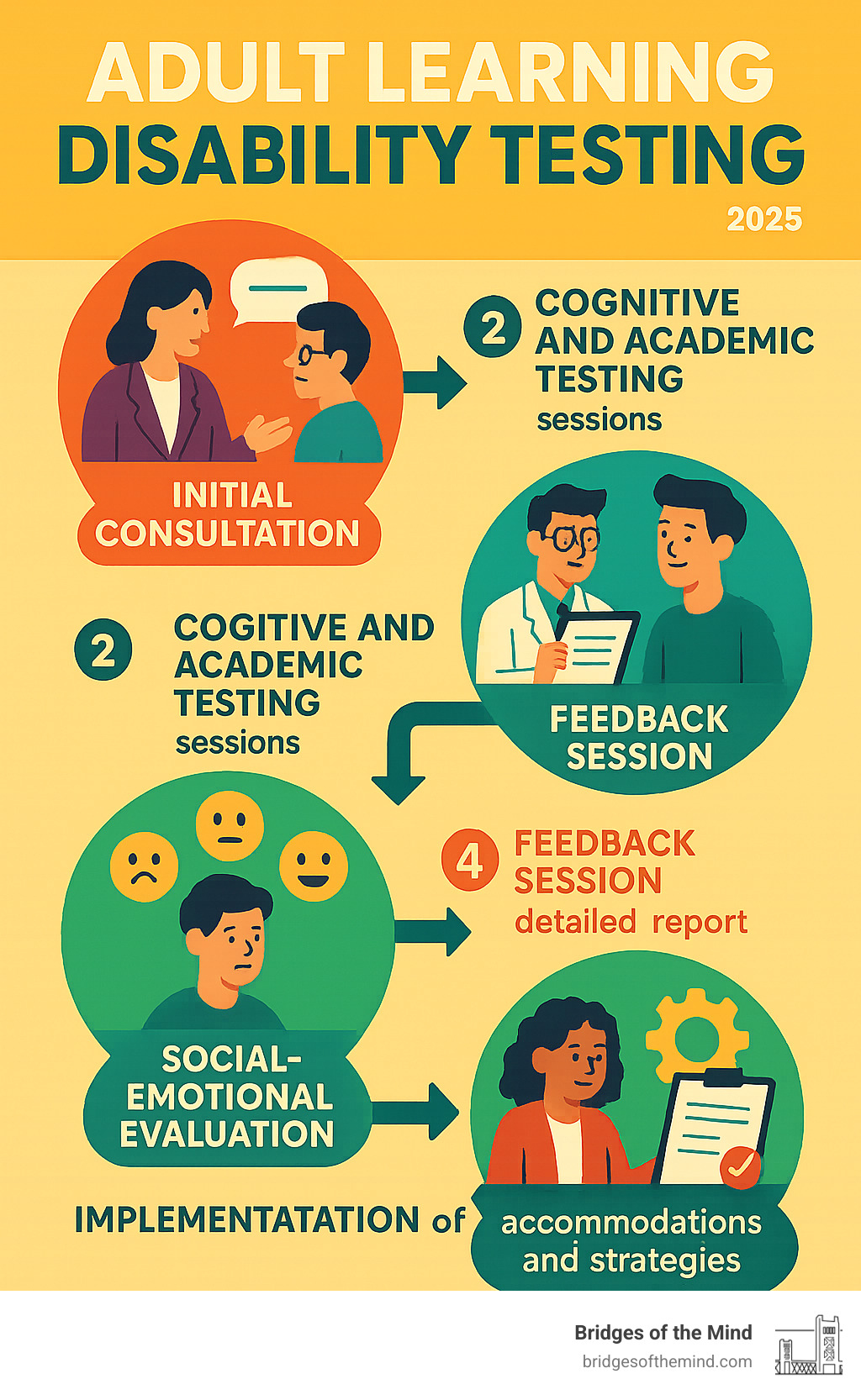
A thorough assessment is an investment of time that yields transformative results. Our evaluation typically involves 6-8 hours of one-on-one testing, usually spread across 2-3 sessions at our Sacramento clinic. This is followed by a detailed feedback session where we walk you through assessment results and next steps.
What You Receive
You will receive a comprehensive report that provides a clear diagnosis when applicable, a full profile of your cognitive strengths and challenges, and personalized accommodation recommendations for work or school. We also include evidence-based strategies for daily life and steps to advocate for support under the ADA or Section 504 when appropriate.
Why Testing Matters
The ultimate goal is empowerment. Testing provides clarity, validation for lifelong struggles, and the official documentation needed to access vital workplace or academic accommodations—all through a lens that respects and celebrates neurodiversity.
Common Signs of Learning Disabilities in Adults
Learning disabilities look different in adults than they do in children and young adults. By adulthood, you’ve likely developed compensatory strategies that mask underlying challenges. However, these core difficulties can still significantly impact your daily life and career success.
Reading and Processing Difficulties
Reading difficulties might show up as unusually slow reading speed, needing to reread sentences multiple times to grasp their meaning, or feeling exhausted after reading even short documents. You might avoid reading-heavy tasks at work or find it hard to follow along with complex texts that students and colleagues handle with ease.
Writing and Communication Challenges
Written expression struggles often manifest as a major gap between your verbal ideas and your ability to write them down. You may struggle with organizing thoughts on paper, frequent grammatical errors, poor spelling despite using spell-check, or awkward sentence structure. Written expression can feel like a constant, draining battle for many adults with learning disabilities.
Mathematical Processing Issues
Math challenges aren’t just about advanced algebra that students learn in school. In adults, this can look like persistent difficulty with mental math, managing a budget, calculating tips, or understanding graphs and charts. Problem-solving that involves numbers can feel uniquely frustrating for adults with learning disabilities.
Memory and Processing Speed Concerns
Memory issues go beyond typical forgetfulness. This could be consistent struggle to remember names, dates, or multi-step instructions that teachers, parents, or supervisors provide. You might find it hard to recall key points from meetings or conversations, impacting your ability to learn new skills and perform tasks efficiently.
Slow processing speed means it takes you longer than others to process information, respond to questions, or complete tasks—even when you fully understand the material. This isn’t about intelligence; it’s about the speed at which your brain makes sense of incoming data.
Executive Functioning and Organization
Organizational problems can include chronic disorganization of your workspace or digital files, difficulty prioritizing tasks, frequently losing items, or struggling to manage multiple projects simultaneously. Time management difficulties show up as challenges estimating how long tasks will take, consistently missing deadlines, or struggling to follow schedules—issues that affect students, working adults, and families alike.
Many adults blame themselves for these challenges, attributing them to laziness or lack of ability. Our testing reveals that these struggles stem from specific neurological differences—not intelligence deficits or character flaws.
Learning Disabilities vs. ADHD: Understanding the Differences
Many people think ADHD is a learning disability. While these conditions frequently occur together and share overlapping symptoms like organizational problems and inattention, they are distinct neurological conditions affecting different aspects of learning and functioning.
Attention deficit disorders primarily affect your brain’s executive functions, impacting your ability to regulate attention, sustain focus on non-preferred tasks, manage impulsivity, and organize thoughts and actions. Learning disabilities, on the other hand, are specific difficulties in processing certain types of information that directly impact academic-based skills like reading, writing, or mathematics.
The high rate of co-occurrence between learning disabilities and attention deficit disorders makes comprehensive evaluations absolutely crucial. An assessment that only looks for one condition may miss the other, leading to incomplete answers and ineffective strategies. You might have one condition, both, or neither—which is why working with qualified psychological professionals who understand these distinctions matters enormously.
This is exactly why we emphasize comprehensive assessment that explores multiple possibilities rather than assuming one diagnosis explains everything. Our approach ensures nothing gets missed, and you receive the complete picture of your unique neurological profile.
Our Personalized Assessment Process
Initial Consultation and History
We listen to your story—your strengths, challenges, and goals. We gather educational, developmental, and mental health history to shape the right testing plan specifically for you. This background information helps us understand whether you attended private schools, received support in public education, or if family members, teachers, or parents noticed similar patterns.
Targeted Test Selection
We choose measures that align with your concerns, including standardized tests for reading fluency and comprehension, written expression assessments, numerical reasoning evaluations, along with processing speed, working memory, and executive functions. Our standardized tests help us determine specific areas where learning disabilities may be impacting your functioning.
Assessment Sessions
You will complete 2-3 focused sessions at our Sacramento clinic. We design a calm, structured environment to help you perform at your best during the assessment process.
Comprehensive Screening
Because mood and mental health can influence learning, we consider social-emotional factors as part of a comprehensive picture of your functioning. This helps us determine whether learning difficulties stem from disabilities or other factors.
Personalized Feedback Session
We schedule a dedicated feedback session to explain assessment results in plain language, discuss your unique cognitive profile, and map out practical next steps tailored to your goals. This feedback session is crucial for understanding how to use your comprehensive report effectively.
Detailed Written Report
You receive a clear, actionable comprehensive report that you can use to request accommodations at work or school, apply for testing accommodations, and guide your own strategies for success.
Common Accommodations and Support Strategies
We help you match accommodations and strategies to your specific profile. The goal is to leverage your strengths while supporting areas that make daily life more challenging than necessary.
Workplace and academic accommodations might include extended time for exams, certifications, and licensing tests, alternative formats for reading such as audiobooks or text-to-speech software, writing supports including speech-to-text and structured templates, note-taking assistance or access to slides and recordings, calculator use and formula sheets for certain tasks, and reduced-distraction testing environments.
Daily life strategies often involve project-management tools and step-by-step task plans, organizational systems that work with your cognitive style, time management techniques tailored to your processing speed, and communication strategies that play to your strengths.
Who We Serve
Our Sacramento clinic serves adults who are highly capable yet have persistent learning difficulties with reading, writing, math, organization, or time management. We frequently work with professionals seeking clarity to advance in demanding roles or pursue licensure, college and university students navigating coursework and testing requirements, and parents who have recently seen similar patterns in their children and want clarity for themselves.
We also serve individuals seeking a neurodiversity-affirming, strengths-based approach that supports their identity and values. For families and executives who prefer enhanced coordination and privacy, we offer Concierge Assessment Services. Our psychological team has experience working with diverse populations, from young adults transitioning from school to career, to established professionals seeking to understand their learning profile.
How Your Assessment Results Can Be Used
Your comprehensive evaluation results serve multiple purposes in supporting your success. You can request reasonable accommodations in higher education and workplace settings, apply for standardized testing accommodations such as extended time, and inform learning strategies, coaching, or therapy with a targeted, personalized plan.
The assessment results also help you share relevant portions with your healthcare providers for coordinated care and clarify long-term goals for career development and ongoing skill-building. Whether you’re a college student, university graduate, or working professional, we believe your profile is more than a diagnosis—it’s a roadmap for how you can learn, work, and live in alignment with your strengths.
Understanding Learning Disabilities: The Science Behind the Struggles
Learning disabilities are lifelong neurological differences that affect how your brain processes information. Think of them as alternative wiring patterns that influence how you acquire, organize, retain, understand, or use both verbal and nonverbal information. It’s a fundamental difference in brain function, not a deficit in intelligence or motivation.
These differences stem from genetic and neurobiological factors that alter brain functioning. They’re not caused by lack of effort, poor teaching, or your educational environment—though these factors can sometimes make challenges feel more intense. People with learning disabilities often have average to gifted thinking and reasoning abilities. If you struggle to perform certain academic or work-related tasks, it’s often due to neurological differences, not lack of intelligence.
Why Adults Seek Testing
Adults often seek evaluations because persistent learning difficulties have become impossible to ignore. Maybe you’re hitting a ceiling in your career, struggling to manage daily tasks that seem effortless for others, or feeling perpetually overwhelmed by responsibilities that colleagues handle with ease. For many, it’s the culmination of a lifetime of feeling “different” without knowing why.
The benefits of being assessed are truly transformative. Evaluation provides immense relief by identifying specific, neurological reasons for long-standing difficulties. This understanding allows you to move past self-blame and develop healthier self-esteem. When you know why certain tasks are challenging, you can stop questioning your abilities and start leveraging your unique strengths.
With an accurate diagnosis, you gain crystal-clear insight into your cognitive profile and can access accommodations that level the playing field. This is your first step toward developing more effective strategies customized to how your brain actually works.
Educational and Professional Applications
Whether you’re currently in school, attending college or university, or working professionally, understanding your learning profile has significant implications. Students can access educational support through their institution’s disability services office. University students often find that accommodations transform their academic experience, allowing them to demonstrate their true capabilities.
For working adults, accommodations in the workplace can be life-changing. Many of our clients report significant improvements in job performance and satisfaction once they understand their learning profile and implement appropriate support strategies.
Resources and Support Systems
We provide extensive resources to help you navigate life with learning disabilities. Our psychological team can connect you with additional support systems, educational resources, and community organizations that understand neurodiversity. We believe in building comprehensive support networks that extend beyond our clinic.
For families with children who may also have learning disabilities, our evaluations often provide valuable insights for the entire family system. Parents frequently report that understanding their own learning profile helps them better support their children’s educational journey.
Technology and Assistive Tools
Modern technology offers numerous resources for adults with learning disabilities. From text-to-speech software to organizational apps, we help you identify which tools will be most beneficial for your specific profile. Our comprehensive report includes recommendations for assistive technology that can significantly improve your daily functioning.
Next Steps After Your Assessment
Personalized Strategy Development
We translate your assessment results into clear, day-to-day strategies you can start using immediately, tailored specifically to your cognitive profile and life goals.
Documentation for Accommodations
Your comprehensive report includes the information that school disability services offices, testing organizations, and workplaces commonly require for accommodation requests.
Coordination of Care
With your permission, we can collaborate with your providers, academic teams, or coaches to support implementation of your personalized plan. This coordination ensures that all members of your support team understand your learning profile.
Ongoing Support Options
We offer related evaluations and can provide anxiety therapy, depression therapy, stress therapy, or trauma therapy if mental health concerns are impacting your learning and functioning. All services are provided in person at our Sacramento clinic by our psychological team.
Insurance and Accessibility
While we are primarily a self-pay practice, we understand that accessing quality psychological evaluations can be a significant investment. We work with families to ensure that cost doesn’t become a barrier to understanding your learning profile. Our insurance acceptance through the Autism Clinic for Kaiser members reflects our commitment to accessibility.
Scheduling Your Assessment
At Bridges of the Mind Psychological Services, we have spent years providing comprehensive learning disability testing through a neurodiversity-affirming lens that celebrates different ways of thinking and learning. Our psychological approach focuses on identifying your cognitive strengths alongside areas of challenge, ensuring you leave with both clarity and actionable strategies for success.
We offer evaluations only at our Sacramento clinic and have no waiting lists—most adults can be assessed within 2-3 weeks. We are a self-pay practice with limited insurance acceptance through our Autism Clinic for Kaiser members.
We tailor every evaluation to fit you specifically. Whether you’re a motivated adult seeking clarity for yourself, parents pursuing answers, or an executive or family seeking Concierge Assessment Services, we’ll shape the assessment process around your goals. Contact our Sacramento office for scheduling and fee information to begin your journey toward understanding and empowerment.